Tree Service in Mountain Home, AR
Got an oak leaning toward the roof or a cedar thicket swallowing the back acre? Tree Service Mountain Home removes, trims and clears trees for homeowners, lake-house owners and landowners in Mountain Home, AR, so your house, your driveway and your view are safe again and the yard is cleaned up when we drive away.
Call for a free estimate: (870) 706-3112Ask for a free estimate
Give us a name and a phone number. Anything else you add helps us show up with the right gear.
- Flat upfront pricing
- Insured
- Free estimates
- We sweep up before we leave
What does a tree service in this part of the Ozarks actually do?
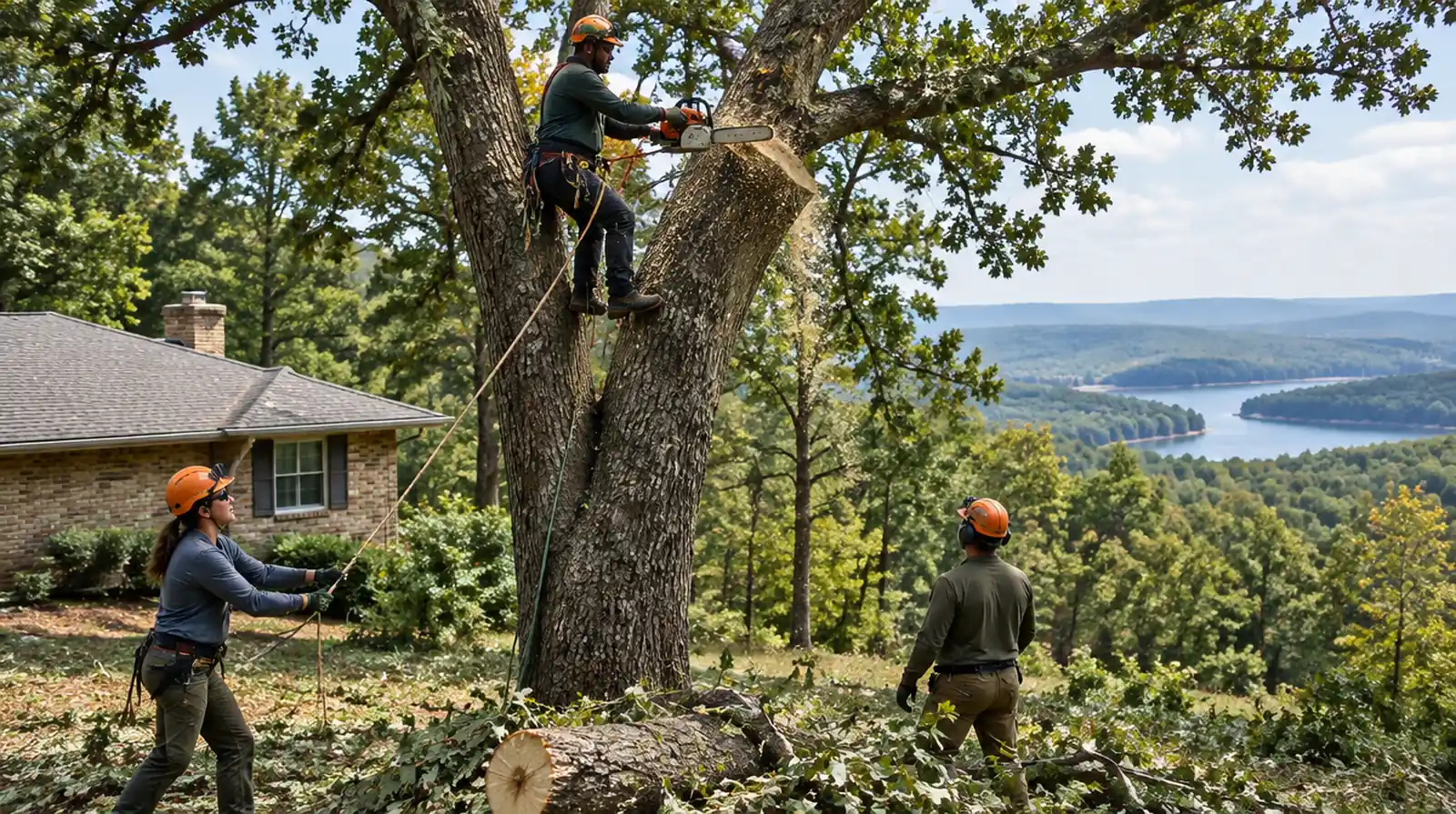
A tree service takes down trees that have to go, cuts back limbs that are causing trouble, grinds out stumps, and cleans up after storms. That's the short list. Around here the job gets shaped by three things you can see from almost any back porch: steep ground, rock just under the topsoil, and a lot of very old oaks growing right next to houses built in the 1970s and 80s.
Most lots in town were carved out of oak-hickory woods. The builders kept the shade trees, which was a nice idea forty years ago. Now those white oaks, post oaks and black oaks are 70 to 120 years old, and many of them are standing over roofs, decks and septic fields. Our work is mostly about dealing with that safely.
Why do so many big oaks in Mountain Home start dying from the top?
Ask anyone who has lived here since the 90s and they'll tell you about the red oaks going bad. Foresters call it oak decline. A long dry spell stresses the tree, the red oak borer moves in, and the crown dies back a few limbs a year. Black oak and scarlet oak on thin, rocky ridge soil get hit the hardest.
The ground is the root of the problem, literally. Much of Baxter County sits on cherty silt loam, a soil full of flint-like rock fragments, laid over dolomite. Water drains through fast and roots can't go deep. In a wet spring the tree looks fine. In an August with no rain it's starving.
A tree that's dying from the top down is not going to recover by itself. Dead red oak wood also gets brittle fast, so the longer you wait, the more of it we have to take down in pieces instead of in big, cheaper sections.
Which trees cause the most trouble on local properties?
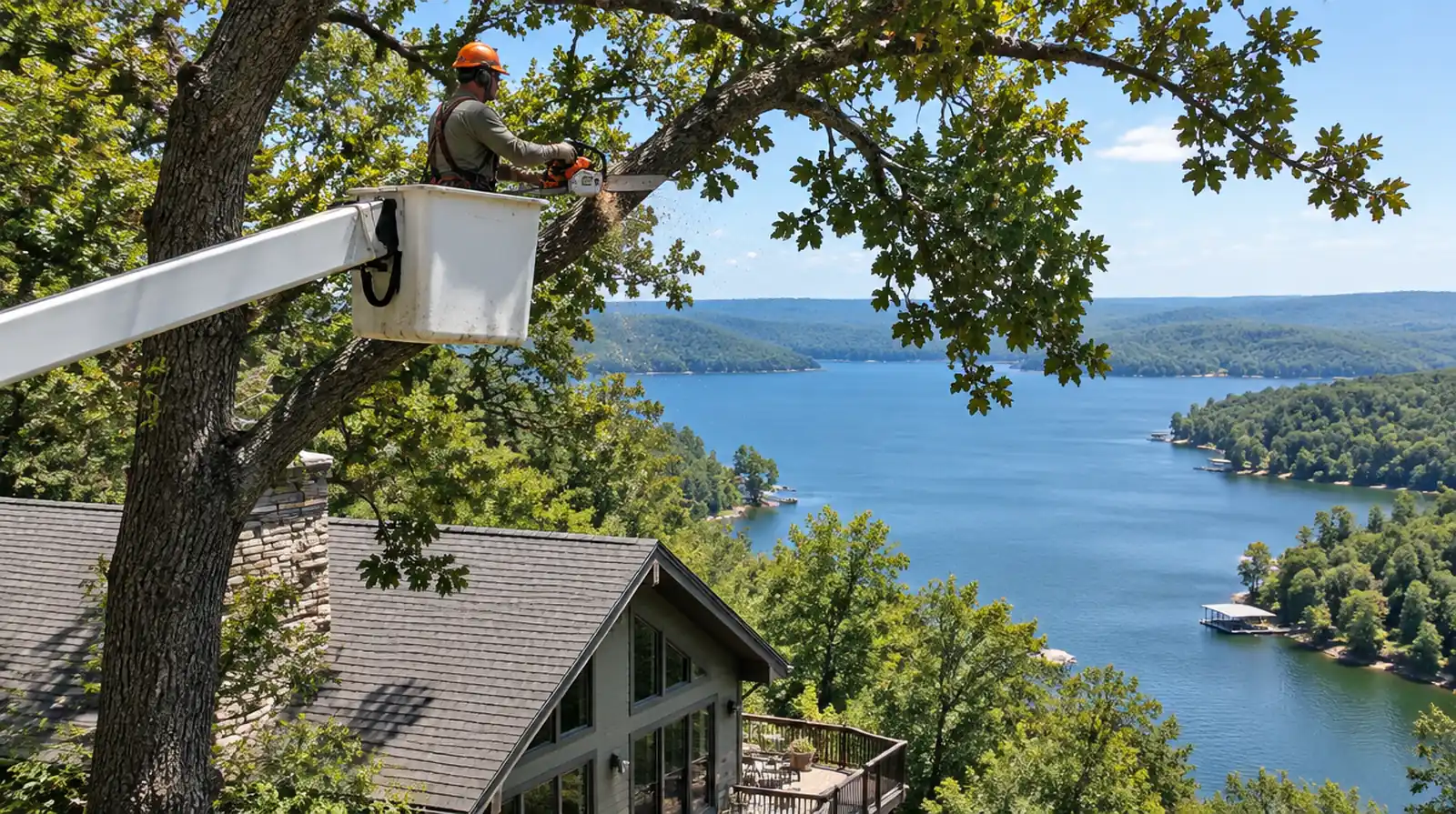
- Black and scarlet oak: prone to decline and borer damage, and they drop heavy dead limbs.
- Eastern redcedar: spreads into every pasture and fence line, burns hot, and crowds out everything else. See our cedar tree removal page.
- Shortleaf and loblolly pine: tall, top-heavy, and a target for pine bark beetles after a dry summer.
- Bradford pear: splits down the middle in wind or ice. Nearly every one planted in the 90s is coming apart now.
- Silver maple and sweetgum: fast growers in older yards that put out weak limbs over driveways.
- Ash: emerald ash borer has reached north Arkansas, and infested ash gets dangerous to climb within a couple of years.
Sycamores and river birch along the creek bottoms are usually healthy. They just get big, and big trees near houses need tree trimming every few years.
What happens when ice or wind hits trees around here?
North Arkansas gets ice. The January 2009 storm is still the one people measure against, when limbs snapped all night and power was out for weeks in some parts of the county. Spring brings the other threat: thunderstorms with straight-line winds that push saturated trees over, root plate and all.
Shallow roots in rocky soil mean trees here often tip over instead of snapping. A tipped tree can still be hung up on a second tree or resting on a roof with a lot of stored tension in it. That's work for a trained crew with rigging, not a chainsaw and a pickup. Our storm damage cleanup page explains how we handle it.
How do steep lots and lake property change the job?
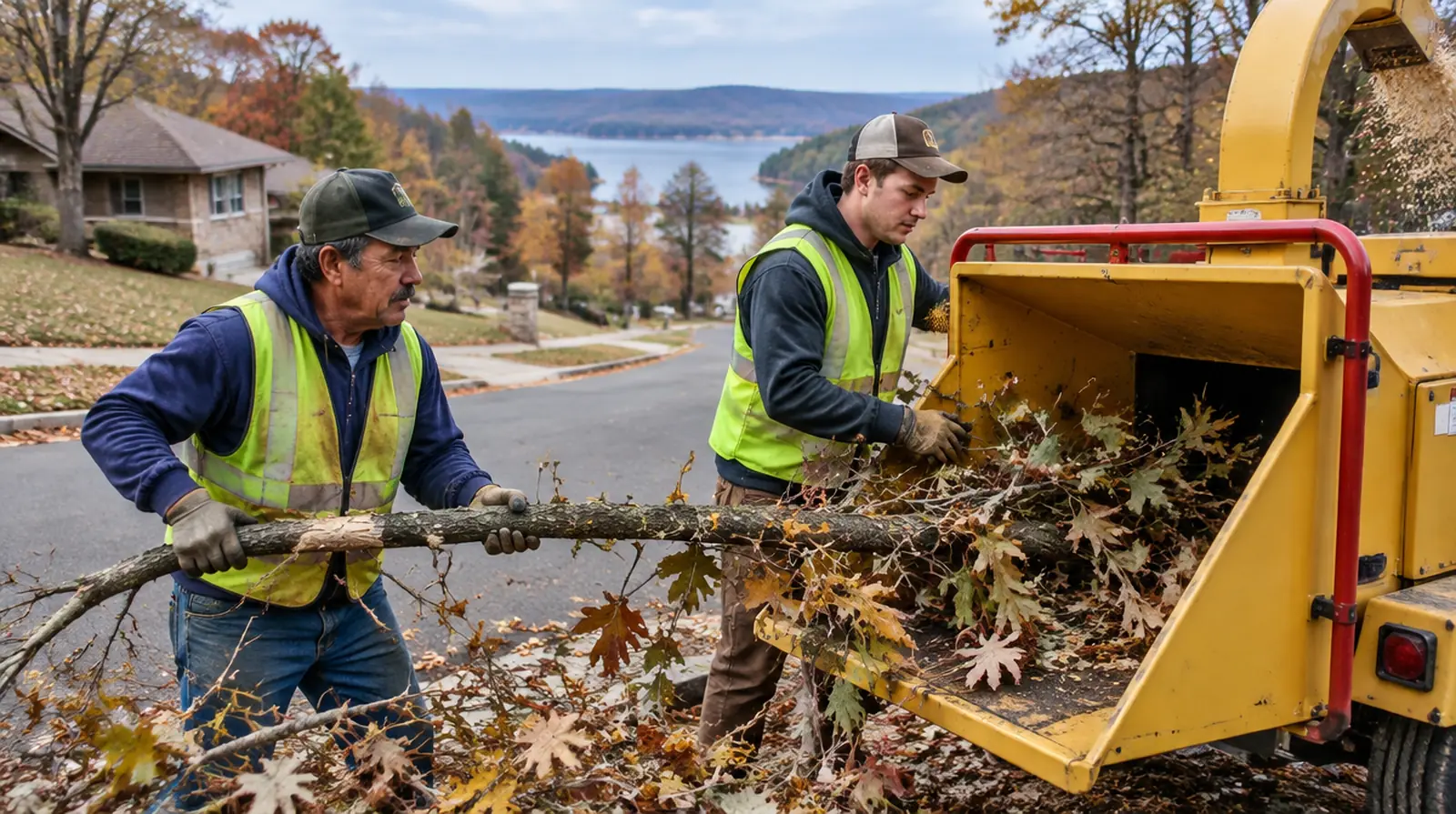
A lot of homes in the area sit on slopes running down toward the water or a hollow. You can't drop a tree downhill on a hillside lot and hope it stops where you want. We rope and lower pieces instead, which takes longer but keeps logs from rolling into a neighbor's boat dock or through a fence.
If your land touches Corps of Engineers shoreline, there's another rule: you generally need a permit from the Corps before cutting or clearing trees on government land along the lake. We'll tell you where your property line appears to stop and won't cut past it without the paperwork in hand.
Tip: If you're not sure where the Corps boundary runs, look for the small metal markers or painted trees along the shoreline. Those mark government land.
What services do we offer?
- Tree Removal: whole trees taken down in sections and hauled off.
- Tree Trimming: deadwood, roof clearance and crown thinning.
- Stump Grinding: below grade, with the chips raked out.
- Storm Damage Cleanup: trees on roofs, driveways and fences after wind or ice.
- Cedar Tree Removal: single cedars to whole thickets.
- Land Clearing: home sites, driveways and overgrown acreage.
- Tree Cabling and Bracing: support for split trunks worth keeping.
- Hazardous Tree Removal: dead, cracked and leaning trees taken down with extra care.
How do we price a job?
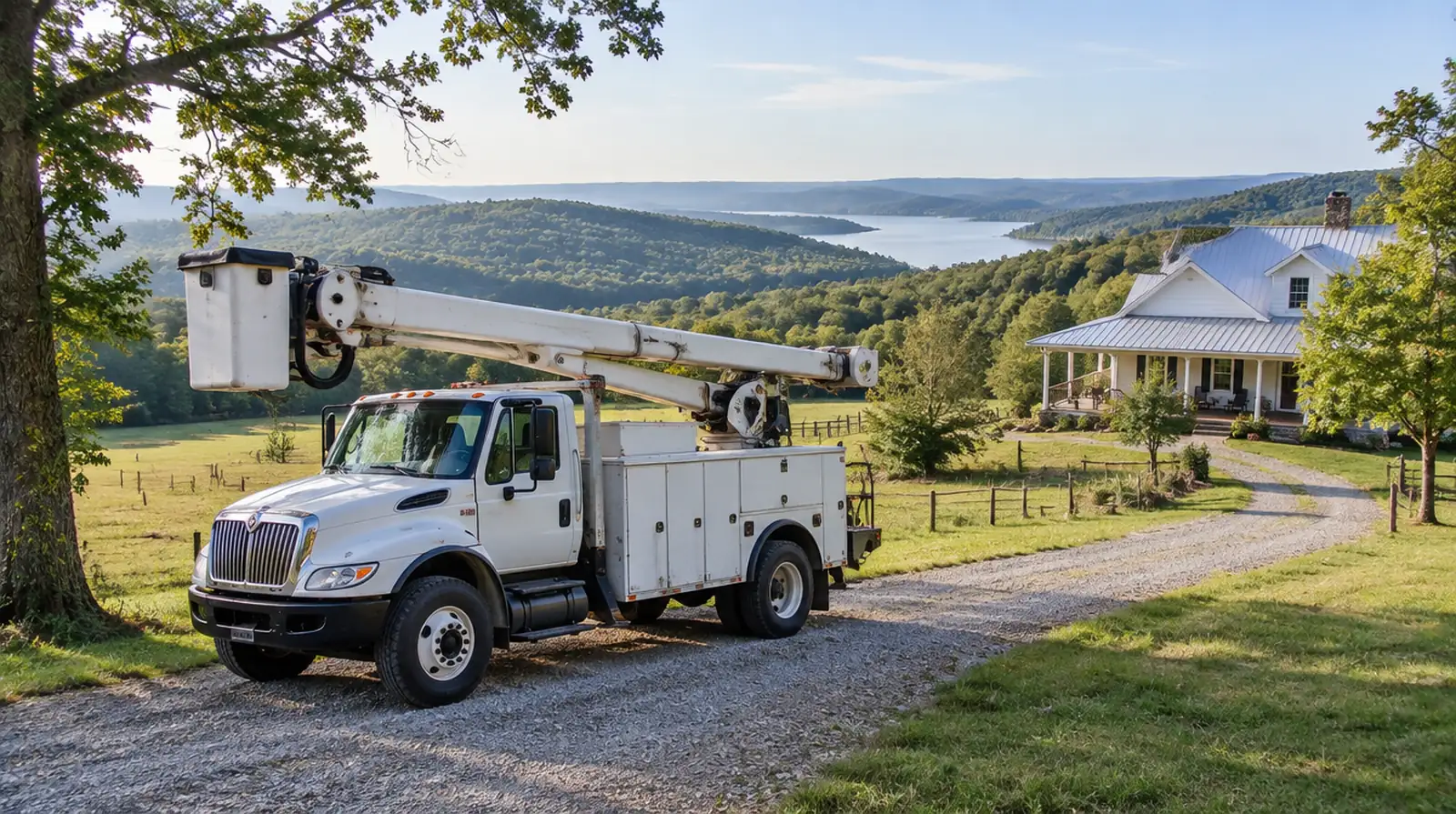
We walk the property, look at the tree and everything around it, and give you one written price. That price includes cutting, hauling and cleanup. It doesn't change once we start unless you add work.
The things that move a price up or down are simple: how tall the tree is, how close it is to the house or power lines, whether a bucket truck can reach it or someone has to climb, and how much wood has to be hauled out. A pine in an open yard is a quick job. A dead black oak hanging over a lake cabin roof on a slope is not.
What does cleanup look like when we leave?
We chip brush on site, haul the logs unless you want firewood, and rake and blow the yard and driveway. If you heat with wood, tell us and we'll cut oak and hickory to stove length and stack it where you want it. We sweep up before we leave, every job.
Common questions about our tree service
How much does tree removal cost here?
It depends on size, access and what's underneath the tree. We don't quote over the phone because two trees of the same height can be very different jobs. The estimate is free and the price we write down is the price you pay.
Do you clean up everything?
Yes. Brush gets chipped, logs get hauled or cut for firewood, and we rake and blow the area. Stump grinding is a separate line on the estimate so you can decide on it.
How soon can you come out?
Estimates are usually within a few days. Scheduled work is often the following week. After big storms there's a waiting list, and trees on houses go to the front of it.
Are you insured?
Yes. We carry liability insurance and can have the certificate sent to you before we start. Ask anyone you hire for the same thing.
Do I need to be home during the work?
You need to be there for the estimate so we can walk the job together. For the work itself, many customers just leave the gate open. We call when we arrive and when we're done.
Want a straight answer about your trees?
Call and tell us what you're seeing. We'll come out, take a look, and give you a written price. No pressure and no charge for the visit.
Call (870) 706-3112